Planning a silent disco takes 4-6 weeks and covers six core decisions: event type, venue selection, equipment rental, music strategy, check-in system, and day-of logistics.
Most silent discos fail because organizers underestimate setup time, skip RF coverage testing, or create chaotic check-in flows that frustrate guests before music starts.
This guide walks you through each decision with checklists, timelines, and cost breakdowns so you avoid the mistakes that ruin first-time events.
Before committing money to deposits, make sure your situation actually supports a silent disco format. The minimum viable event size is 50 guests, and below that threshold, regular speakers create better energy and cost less.
Minimum requirements:
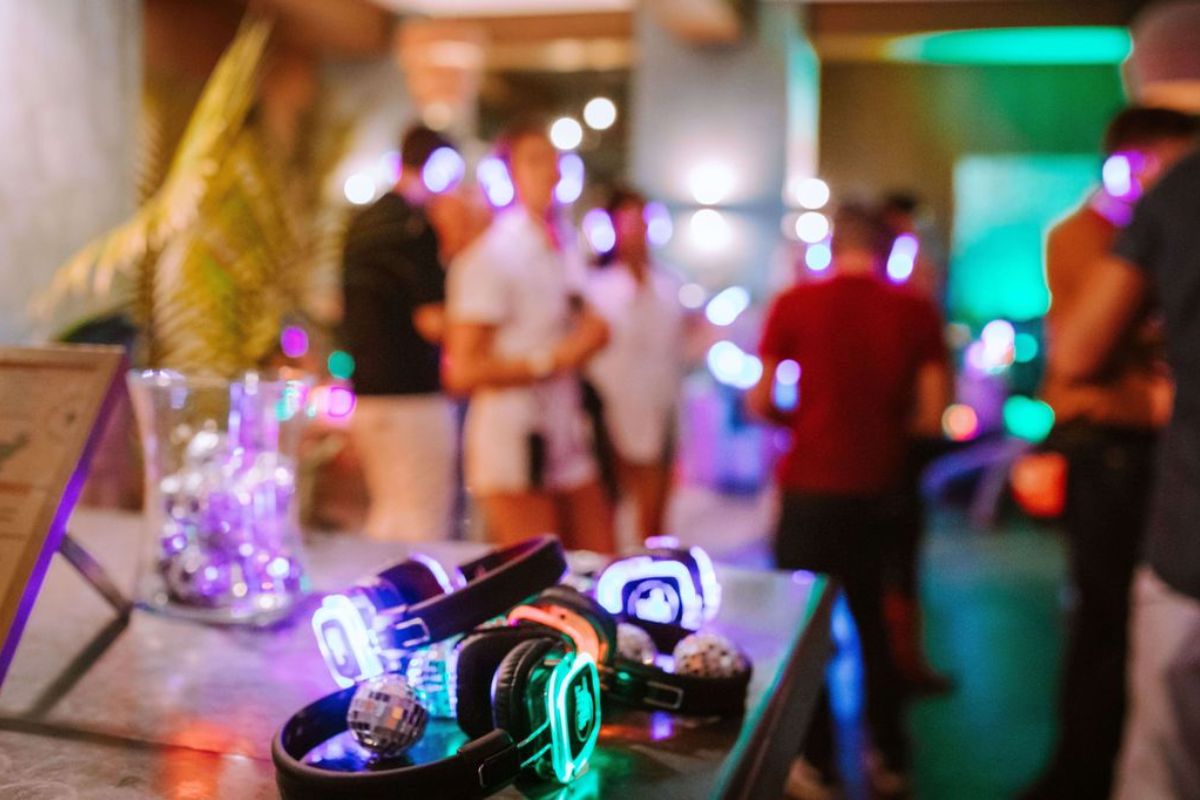
Silent discos need 50+ guests to create the LED color-shift effect that makes them unique. Below 30 people, the visual impact disappears and you're just playing music through expensive wireless headphones.
Your venue needs stable power within 20 feet of where transmitters will sit at 6-8 feet height, centrally located. Open floor plans work better than layouts with thick concrete walls that create dead zones.
Solo setup works for events under 50 guests. Events with 100-200 guests need at least two people: one for tech, one for check-in. Events over 200 require three or more.
Budget minimum:
Silent discos cost $25-35 per guest for equipment rental, venue, and basic production. A 100-person event runs $2,500-3,500 minimum.
A 200-person event costs $5,000-7,000. First-time organizers need 4-6 weeks for venue booking, equipment rental, and music curation.
Different event types create different operational challenges, and understanding yours upfront determines how you size equipment and staff.
Event types:
Equipment scaling:
Add 10-15% buffer to headphone counts for battery failures, loss, and late arrivals.
Your venue choice directly impacts whether guests experience clean audio everywhere or constant dropouts in half the space. RF signals behave differently than sound waves, so venues that work for traditional DJ setups sometimes fail for silent discos.
Space requirements:
Calculate 10-12 square feet per guest for dance floor capacity. A 100-person event needs 1,000-1,200 sq ft of clear dance space, plus 80-100 sq ft for check-in and 30-40 sq ft for equipment tables elevated at 6-8 feet.
RF-friendly vs RF-hostile venues:
Power and infrastructure:
Count outlets within 15-20 feet of central transmitter placement. You need one outlet per stationary transmitter plus two extras for charging stations. Test outlets with a phone charger before booking; older venues have dead circuits or shared breakers that trip under load.
Permits and insurance:
Some municipalities require permits for gatherings over 100 people even with silent discos. Event liability insurance costs $150-350 for single-event coverage and protects against equipment damage and guest injuries. Most rental companies require proof of insurance before delivering headphones.
Rental decisions determine whether you have enough headphones for latecomers and whether you get support when equipment fails at hour two of your event.
How many headphones:
Take the confirmed guest count and add 10-15% buffer. For 100 guests, rent 110-115 headphones. For 200 guests, rent 220-230. Don't under-rent to save money; running out 45 minutes into the party kills momentum.
Channels and transmitters:
Each channel requires one transmitter plus one audio source (DJ mixer, laptop, phone).
Rental company red flags:
Questions to ask rental companies:
Rental costs (U.S. averages, 2024-2025):
Weekend rates run 20-30% higher than weekday. Holiday weekends add another 30-50% surge.
The music you program determines whether guests distribute evenly across channels or whether 80% cluster on one channel while two sit empty.
Channel strategy:
The goal is 30-35% of guests on each channel at any moment, not 70% on one and two empty channels. Balanced distribution creates the visual LED color-shift effect.
Live DJs vs playlists:
Briefing DJs:
DJs need to understand they're competing for ears, not commanding the room. Give them these guidelines:
Playlist curation:
Build 4-6 hour playlists per channel so music doesn't loop during the event. Match BPM ranges across channels so switching feels smooth:
Don't duplicate the same song on multiple channels at the same time; guests think headphones are broken.
Your check-in system determines whether guests enter smoothly in 15 seconds or wait in 20-minute lines that delay the party start.
Check-in stations:
Distribution systems:
ID swap has the lowest loss rate because guests cannot leave without retrieving their driver's license.
Explaining to first-timers:
40-50% of guests will struggle with channel switching in the first 10 minutes if not briefed. At check-in, demonstrate using a test pair:
"Press this button to switch channels: red, green, blue. Each color plays different music. Volume wheel is here. Return headphones before leaving, or you'll be charged."
Post visual signage near the entrance with large format posters:
Station one staff member on the dance floor during first 30-60 minutes to help confused guests.
Return process:
Stop music 15 minutes before end time and announce repeatedly: "Please return headphones NOW". Station staff at exits to intercept guests leaving with headphones still on. Count returned units against check-in logs immediately while guests are present.
For credit card holds, charge immediately before guests leave the venue if the headphones aren't returned. Budget 2-5% loss rate for private events, 5-10% for large public events.
Setup isn't just plugging in equipment; it's testing RF coverage in every corner to catch dead zones before guests arrive, and complaining about dropouts.
Set up timing:
Timeline (90-minute standard):
RF walk-test and dead zone mapping:
Put on headphones tuned to each channel and walk the entire venue. Listen for signal dropouts, static, or volume dips. Common dead zones include:
Fixes: Raise transmitter height 1-2 feet, reposition more centrally, or switch to high power mode. Aim for 95%+ coverage on main dance floor, 80%+ in secondary areas.
Staff roles:
Floor monitor: Helps confused guests first hour
Equipment rental dominates your budget in ways traditional speaker rentals don't because you're renting 100-300 individual wireless units instead of two speakers.
Cost breakdown by region (100-person event):
Cost by event size (mid-market):
Per-guest costs drop as headcount increases because the venue and staff don't double when guests double.
Ticket pricing:
For public events, target a 50-60% profit margin. If the per-guest cost is $28, charge $45-55 for tickets. If the cost is $35, charge $55-70.
Where to save money:
Where not to cut corners:
Most first-time failures stem from underestimating operational complexity, not equipment malfunctions.
Setup and technical:
Operational:
Guest experience:
Financial:
How long does it take to plan a silent disco event?
4-6 weeks for public events (venue booking, equipment rental, promotion) and 2-3 weeks minimum for private parties.
What is the minimum guest count for a silent disco?
50 guests to create the LED color-shift effect. Below 30 people, regular speakers cost less and create better energy.
How much does a silent disco cost per person?
$25-35 per guest for equipment, venue, and production. A 100-person event costs $2,500-3,500 total.
Do you need live DJs for silent discos?
No. Pre-built playlists work well for events under 100 people or budget-conscious hosts. DJs add energy for 100+ guest dance-focused events but cost $250-600 each.
How do you prevent guests from stealing headphones?
Use ID swap (1-3% loss rate) or $25-40 cash deposits (2-4% loss rate). Station staff at exits to intercept guests leaving with headphones.
Can one person set up a silent disco alone?
Yes, for events under 50 guests. Events with 100-200 guests need 2 people minimum (tech + check-in). Events over 200 need 3+ people.
What venues work best for silent discos?
Warehouses, gymnasiums, and outdoor pavilions with open floor plans provide excellent RF coverage. Avoid basements, historic buildings with thick walls, and multi-story venues.
How many channels should a silent disco have?
3 channels for 100+ guests creates the full LED experience. 2 channels work for 50-150 guests. 1 channel for under 50 with uniform music taste.
What insurance do silent disco events need?
Single-event liability insurance costs $150-350 and covers equipment damage and guest injuries. Most rental companies require proof before delivering headphones.
How far in advance should you book silent disco equipment?
3-4 weeks for weekend dates during peak season. 2 weeks for weekday or off-season events.