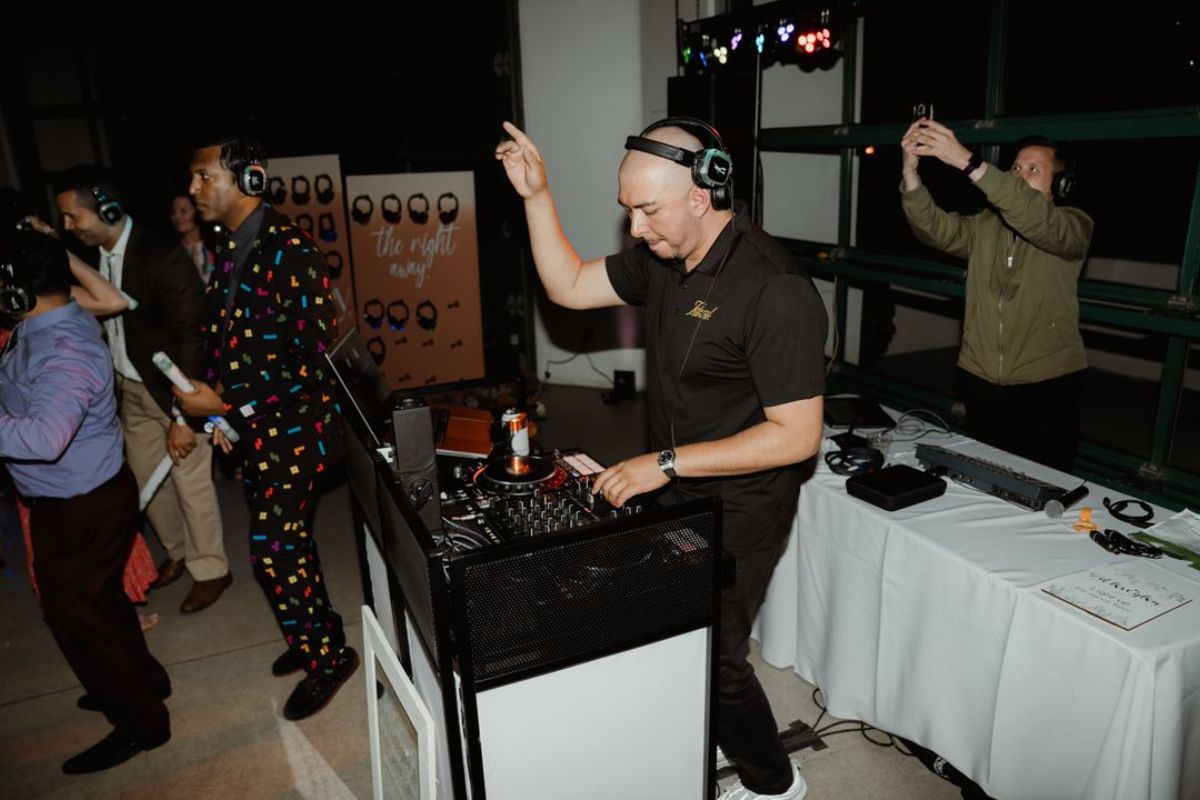
You see them at the party: glowing headphones in red, green, and blue. Everyone's dancing, switching between channels, controlling their own volume. But here's what catches you: they're not regular Bluetooth headphones.
A silent disco headphone uses RF wireless technology to receive audio from transmitters broadcasting 2-3 music channels simultaneously via 863-865 MHz radio frequencies. LED lights glow red, green, or blue, showing which channel you're listening to. Battery life runs 6-10 hours with a 300-meter range.
This guide covers how the technology works, the three main types, key features that matter, and rental vs. purchase decisions with real costs.
The RF wireless system makes multi-channel silent parties possible. Here's what happens when you turn on the headphones.
A transmitter broadcasts audio on 2-3 different frequencies; typically 863-865 MHz. Each frequency represents one music channel. Your headphone has a built-in RF receiver that picks up these broadcasts when you power on. No pairing. No WiFi.
Press the channel button and the receiver switches frequencies. Your LED light changes color: red for Channel 1, green for Channel 2, and blue for Channel 3. Volume control works independently. One person cranks it to maximum while another keeps it low for conversation. Both hear the same channel at their preferred level.
This differs from Bluetooth completely. RF prevents signal drops in crowds of 200+ people, supports unlimited headphones on the same frequency, and reaches 300 meters in open spaces. Through walls that drops to 100-150 meters. The transmitter technology handles hundreds of receivers without the interference Bluetooth creates when 50+ devices compete for bandwidth.
Not all silent disco headphones are the same. Three distinct types exist, each designed for specific event environments and audio priorities.
1. Standard Models
Standard models handle most events. Weddings with mixed ages. Corporate gatherings. House parties. They deliver balanced audio with 6-8 hour battery life. Physical specs: 250-280 grams weight, standard polycarbonate plastic, 20-25mm memory foam padding, over-ear design. Cost runs $30-50 per unit to buy or $8-12 to rent in the US.
2. Silent Rave Models
Silent rave models dominate high-energy environments where bass matters. Music festivals. EDM events. Beach parties. The construction is heavier at 280-320 grams with reinforced plastic and rubber bumpers. Thicker 30-35mm padding creates better bass seal. Battery life extends to 8-10 hours. Enhanced bass response and louder maximum volume satisfy electronic music fans. Thicker headbands prevent cracking under rough handling. Cost: $50-80 to buy, $12-15 to rent.
3. Silent Concert Models
Silent concert models prioritize audio quality. Acoustic performances. Silent yoga. Meditation sessions. They're the lightest at 220-250 grams with audiophile-grade 40mm drivers versus 30mm standard drivers. Better ear cup seals block ambient noise. Cost reflects premium audio; $60-100 per unit.
Certain features directly impact whether your silent disco succeeds or fails. These eight make the real difference in guest experience.
Multi-channel audio: Standard systems broadcast three channels simultaneously. Channel 1 plays EDM, while Channel 2 delivers hip-hop, and Channel 3 spins classics. Guests switch instantly. Single-channel systems defeat the whole purpose.
LED indicators: Red, green, and blue lights show what each person hears. When half the room glows green, everyone knows Channel 2 just dropped something special. This creates "color wars" where crowds form around popular channels.
Battery runtime: Professional models run 6-10 hours. Cheaper versions die after 4-5 hours. For weddings and outdoor events lasting 6+ hours, dead headphones at hour 5 kill the party.
Wireless range: Quality headphones reach 300 meters in open spaces. Budget models max out at 100-150 meters. Performance drops 40-60% through walls; concrete reduces the signal more than drywall.
Over-ear design: Ear cups surround your ears rather than pressing on them. On-ear models create pressure points that ache after 90 minutes. Memory foam padding stays comfortable for 4+ hours while cheap foam compresses flat and gets sweaty.
Independent volume control: Each user sets their own level from whisper-quiet to club-loud. Essential for hearing sensitivity differences.
Accessible channel switching: The button should sit on the right ear cup where you can find it easily. Some models hide it on the back.
Durable construction: Quality models use 3-4mm polycarbonate. Cheap versions use under 2mm and crack when dropped.
Many people wonder if regular Bluetooth headphones work for silent discos. The technology fundamentally doesn't support the requirements; here's why.
Regular Bluetooth headphones can't replace silent disco headphones at events. Bluetooth signals interfere when 50+ devices operate nearby. Range limits force guests within 30 feet of the audio source. No multi-channel capability means one playlist for everyone.
The decision to rent or buy comes down to usage frequency and total cost over time. Here's the honest breakdown with regional pricing.
Rental runs $5-15 per headphone, depending on quality and region. In the US, expect $8-12 per unit, UK pricing hits £7-10, and Canada runs $10-14 CAD. A 100-headphone setup costs $800-1,200 for one night, with deposits of $50-150 per unit required upfront.
We rent at silentdiscopartyrentals.com with US pricing starting at $8 per unit, free delivery on 50+ orders, and transparent $75 deposit terms that fully refund for normal wear.
Purchase demands a higher upfront investment. Quality headphones cost $30-80 per unit. A 100-headphone system runs $3,000-8,000. Ongoing costs include battery replacements every 200-300 charge cycles at $5-10 per unit, cleaning supplies, storage cases, and replacement ear cushions. Budget 10-15% of the purchase price annually.
When to rent: One-time events. Occasional use (1-2 times per year). Testing before purchase.
When to buy: Hosting 3+ events annually. Running a rental business. The break-even point hits around event 6.
Hidden rental costs include delivery fees and rush order premiums. Hidden purchase costs include storage space and obsolescence as technology improves.
Watch for these warning signs that indicate cheap equipment is destined to fail at your event.
No replacement parts - Forces buying entire new units when ear cushions wear out
Comfort determines whether guests actually wear the headphones for the full event. The difference between 2-hour tolerance and 8-hour wearability comes down to specific design elements.
Over-ear design with memory foam separates comfort from unbearable. Ear cups fully surround your ears rather than pressing on them. On-ear models ache after 90 minutes.
Memory foam conforms to the head shape and doesn't compress. Cheap foam flattens within an hour and gets sweaty.
Models under 250 grams prevent neck strain during hours of dancing. Heavier models over 300 grams cause soreness. Adjustable headbands need to extend 6-8cm minimum to fit all head sizes.
Too tight causes headaches within 90 minutes. Breathable materials like mesh or perforated padding ventilate, while solid plastic ear cups trap heat.
Before renting 100 units, request a demo from us at silentdiscopartyrentals.com. Wear it for 30 minutes. Walk around. Dance. Switch channels. If it's uncomfortable at minute 30, imagine hour 4.
Different headphone types excel at different events. Match the right equipment to your specific needs for maximum guest satisfaction.
Standard headphones work for wedding receptions with guests aged 8 to 80, corporate networking events where conversation matters, and house parties of 30-100 people.
Silent rave headphones dominate multi-day music festivals with EDM stages running till 4 AM, outdoor concerts where equipment takes weather abuse, and beach parties where bass drives the experience.
Silent concert headphones serve acoustic performances where pristine audio matters, silent yoga with guided meditation, and museum programming.
Finding reliable suppliers separates successful events from disasters. Here's where to source quality equipment and exactly what to ask before committing.
For rentals in the US, we offer packages at silentdiscopartyrentals.com starting at $8 per headphone with free delivery on 50+ units, fully charged equipment, free scheduled pickup, and clear $75 refundable deposits for normal wear.
Other US options include Silent Events (West Coast), Quiet Events (East Coast), and local AV rental companies. Book 4-6 weeks ahead.
Questions to ask rental companies:
For purchases, Silent Sound System supplies bulk orders with warranties. Amazon carries smaller quantities for testing.
Purchase checklist:
Silent disco headphones don't work alone; they need supporting infrastructure. Understanding these requirements prevents day-of-event disasters.
Headphones need transmitters; one per channel, so three for three channels. Each transmitter connects to an audio source like a DJ controller, laptop, or phone. The transmitter setup takes 10-15 minutes once you understand it.
Compatibility warning: Not all headphones work with all transmitter brands. Some use proprietary RF frequencies outside the standard 863-865 MHz. Verify compatibility before mixing equipment from different suppliers.
Events over 6 hours need charging stations for backup power. Position a check-in table near the entrance for distributing headphones and collecting deposits.
Setup 60 minutes before guests arrive. Test signal throughout the venue. Walk the perimeter. Check dead zones. Concrete walls reduce signal 40-60% more than drywall. Follow this setup guide for a detailed walkthrough.
How do silent disco headphones work?
Silent disco headphones use RF wireless technology broadcasting on 863-865 MHz frequencies. Transmitters send audio signals on different frequencies representing separate music channels. Built-in RF receivers in each headphone pick up these broadcasts automatically when powered on.
How much does it cost to rent silent disco headphones?
Silent disco headphone rental costs $8-12 per unit in the US (£7-10 UK, $10-14 CAD Canada). A 100-headphone setup for one event runs $800-1,200 with $50-150 refundable deposits per unit.
Can you use regular Bluetooth headphones for a silent disco?
No, Bluetooth headphones cannot replace silent disco headphones at events. Bluetooth lacks multi-channel capability, has a limited 10-30 meter range, and suffers interference when 50+ devices operate nearby.
What is the range of silent disco headphones?
Professional RF silent disco systems reach 300 meters in open outdoor spaces. Indoor range drops to 100-150 meters through walls, depending on building materials like concrete or drywall.
How long do silent disco headphone batteries last?
Quality silent disco headphones run 6-10 hours per charge. Standard models last 6-8 hours while silent rave models extend to 8-10 hours. Budget versions often die after 4-5 hours.
Are silent disco headphones comfortable for long events?
Over-ear silent disco headphones with memory foam padding stay comfortable for 4-8 hours at weddings and festivals. Cheap foam and on-ear designs become uncomfortable after 2 hours of continuous wear.
How many channels do silent disco headphones have?
Standard silent disco headphone systems broadcast 3 channels simultaneously on different RF frequencies. Each channel plays separate music. Some basic budget systems offer only 2 channels.
Where can I rent silent disco headphones?
Silentdiscopartyrentals.com offers silent disco headphone rentals starting at $8 per unit with free delivery on 50+ unit orders in the US. Other options include Silent Events and Quiet Events nationally.
Should I buy or rent silent disco headphones?
Rent silent disco headphones for one-time events or occasional use of 1-5 events per year. Buy if hosting 6+ events annually when accumulated rental costs equal the purchase investment.
Do silent disco headphones need WiFi?
No, silent disco headphones do not need a WiFi or internet connection. They use RF radio frequency technology with direct radio wave communication between transmitters and headphone receivers.